
The Podcast for Cattle Producers
For complete access to free resources, all podcasts, blog posts and RancherMind information please go to https://www.casualcattleconversations.com/
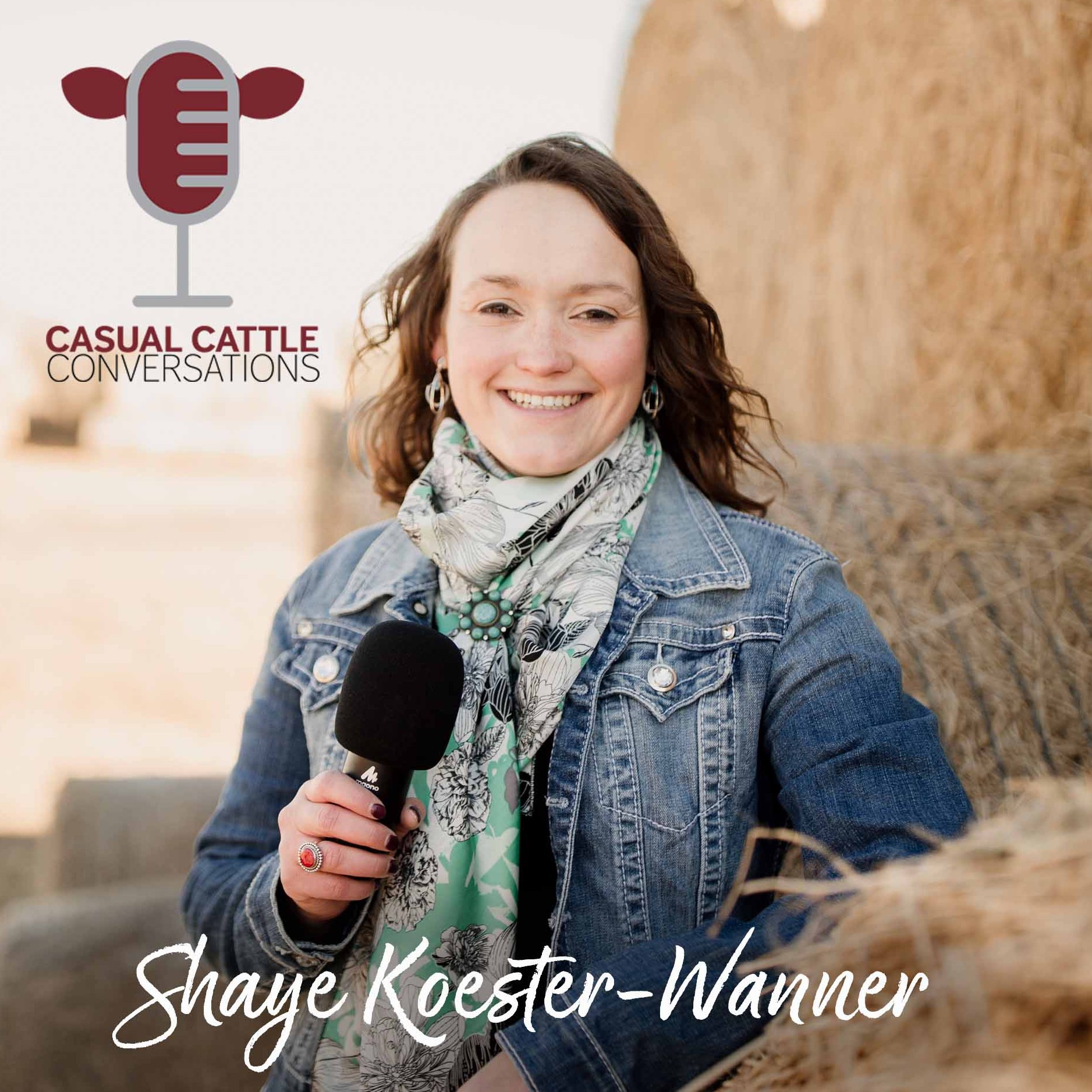
Casual Cattle Conversations is the podcast for beef cattle producers and ranchers to explore new ideas and hear stories that will help them improve their current management practices. Shaye Koester - Wanner connects listeners to other cattle producers and beef industry experts to discover what management practices, industry trends, current events and inspiring stories are impacting today’s beef cattle industry.
For complete access to free resources, all podcasts, blog posts and RancherMind information please go to https://www.casualcattleconversations.com/
5 days ago
5 days ago
On today's show, Shaye Wanner interviews Saskatchewan ranchers John and Deanne about using Vence virtual fencing on their 400 cow-calf commercial operation near the Bronson Forest. They explain how virtual fencing improves utilization on rough, boggy forest lease country where conventional fencing is difficult and expensive, while saving labor, supporting planned/rotational grazing, and helping soil health by controlling stock density and drift with back fences.
They describe added benefits like better monitoring for predation claims, reducing temporary electric fencing on rented land, and sorting groups (heifers, main herd, and open cows) using different virtual fences, achieving about a 95% success rate in a week. They discuss software tools like maps and heat maps, training protocols, cow-to-cow variation in responses, challenges with bull collar retention, collar loss rates improving with tighter fitting, and battery life lasting closer to six months than nine.
Learn more about what Vence could look like on your operation here: https://bit.ly/4kfWrCG
Catch more conversations like this one and learn more at https://www.casualcattleconversations.com/
Monday May 18, 2026
Monday May 18, 2026
On this episode of the Casual Cattle Conversations Podcast, Shaye interviews first-generation Texas rancher Kim Jungkind about staying curious to reduce cattle stress and improve performance. Kim shares how observing cattle led her to test music and color preferences: her herd moved away from rock music but gathered closely to Bach, especially Yo-Yo Ma’s cello, which she now plays during feeding and stressful events like trailering or difficult births to calm the herd; she connects stress reduction to better weight gain by preventing metabolic energy loss.
She also found cattle are drawn to yellow after placing art in a corral, and notes cattle see yellow best and blue well, inspiring practical changes like using yellow flags on sorting sticks. Kim recounts transitioning from nursing and academia to ranching after inheriting her father-in-law’s operation, receiving community support through a local church, and facing a major fire early on. She recommends helping new ranchers network and directs listeners to order her book, “Back to the Barn and Bach,” at www.insightskj.com.
Links and Resources
Learn more about Cargill here: https://bit.ly/4e1qygS
Learn more about Vence here: https://bit.ly/4kfWrCG
Catch more conversations like this one and learn more at https://www.casualcattleconversations.com/
Monday May 11, 2026
Monday May 11, 2026
On this episode of Casual Cattle Conversations podcast, Shaye interviews Jaclyn Ketchum, who grew up on a registered Red Angus ranch using AI and embryo technologies, earned advanced degrees in reproductive physiology, and now runs her family’s custom AI business while expanding embryo work. Ketchum explains benefits of AI and fixed-time AI with synchronization, including access to superior genetics at lower cost than buying bulls, use of sexed semen, improved early conception linked to heavier calves, more uniform calf crops, and reduced bull-to-cow ratios with cleanup bulls.
She discusses why some producers still heat-detect, heifer protocol considerations, and how weather can reduce estrus expression and conception. Key success factors include communication, strict protocol timing, facility readiness, proper product handling and dosing, semen storage and shipping, skilled technicians, and managing expectations before and after AI.
Mentioned Episodes
Lacey Quail on Improving Preg Rates: https://www.casualcattleconversations.com/casual-cattle-conversations-podcast-shownotes/lacey-quail
Jennifer Koziol on Bull Fertility: https://www.casualcattleconversations.com/casual-cattle-conversations-podcast-shownotes/p4fffrydex27m1zkm1cj7bmrgpp56d
Links and Resources
Learn more about Cargill here: https://bit.ly/4e1qygS
Learn more about Corteva here: RangeAndPasture.com/CattleConversations
Learn more about CattleMax Here: https://bit.ly/4aG7K5q
Catch more conversations like this one and learn more at https://www.casualcattleconversations.com/
00:00 Why AI Matters
00:18 Meet Jaclyn Ketchum
01:50 AI and Fixed Time Benefits
07:53 Why Skip Synchronization
11:17 Heifer Protocol Basics
13:20 Planning a Successful AI Day
22:07 Heat Detecting 21 Day AI
24:35 Weather and Conception
27:45 Resync and Backup Plans
30:18 Sync for Natural Service
32:37 Repro Efficiency Big Picture
34:45 Final Takeaways and Wrap
Monday May 04, 2026
Monday May 04, 2026
Monday Apr 27, 2026
Monday Apr 27, 2026
Monday Apr 20, 2026
Monday Apr 20, 2026
Monday Apr 13, 2026
Monday Apr 13, 2026
Today, Shaye welcomes Jonathan Wells of the Cargill Animal Nutrition Team to discuss fly control strategies for pasture cattle, focusing on horn flies’ economic impact and how to choose tools for an operation. Wells says horn flies drive about $2 billion in annual losses and can spread diseases like mastitis and anaplasmosis while reducing performance through increased heart rate, higher water intake and urinary nutrient loss, reduced nitrogen retention, and about a 15% drop in average daily gain.
They compare adult-killing topicals and ear tags (and resistance concerns) with feed-through IGRs like Altosid (methoprene) that break the fly life cycle in manure. Wells explains the Altosid XRB extended-release bolus, given once at season start and releasing IGR for about 195 days, dosing guidance for cows and calves, application tips, compatibility with other controls, and visual signs of adequate control.
Learn more about Cargill here: https://bit.ly/4e1qygS
01:33 Why Fly Control Matters
03:12 Hidden Performance Losses
05:04 Fly Control Options
07:24 Breaking The Fly Cycle
08:24 Altosid XRB Bolus
10:57 Bolus Release Science
12:27 Dosing Cows And Calves
14:08 Safety And Application Tips
18:17 How To Judge Control
20:36 Producer Field Experience
Monday Apr 06, 2026
Monday Apr 06, 2026
On this episode of the Casual Cattle Conversations Podcast, Shaye interviews Corteva forage specialist, Sam Ingram, about prioritizing pastures and hay land to maximize forage production and improve cattle margins by lowering feed costs through grazing. Ingram explains how fertility, weed control, and grazing rest increase tonnage, forage quality, and carrying capacity, emphasizing soil testing and sticking to a consistent testing time to guide nutrient plans.
He discusses the value of legumes like white clover and annual lespedeza for quality and nitrogen fixation and introduces Corteva’s NovaGraz, a non-residual broadleaf herbicide that controls weeds such as biennial thistles, ironweed, buttercup, plantains, wild carrot family species, poison hemlock, and parsnip while maintaining key legumes, offering flexibility for hay sales and crop rotation. He also describes UltiGraz, which combines herbicide and fertilizer in one pass for efficiency. The conversation addresses drought and wildfire impacts, stressing post-disaster planning, avoiding grazing too soon, and using sacrifice areas and stored feed to protect forage cover. Learn more about Corteva Pasture Products here: https://www.corteva.com/us/products-and-solutions/pasture-management/product-finder.html
Catch more conversations like this one and learn more at https://www.casualcattleconversations.com/
Other Links and Resources
Learn more about CattleScales here: https://bit.ly/4dqqTtr
Learn more about Cargill here: https://bit.ly/4e1qygS
Learn more about Performance Livestock Analytics here: https://bit.ly/47PxY3W
Monday Mar 30, 2026
Monday Mar 30, 2026
In this episode of the Casual Cattle Conversations Podcast, Shaye interviews Andrew Bredeweg about his multi-generational family farm in southwestern Indiana and why supporting family agriculture businesses helps rural communities thrive. Andrew explains how their operation evolved from a sustenance farm and dairy into a cattle-focused business that also farms under 500 acres, and how his kids are gaining ownership and business experience through feeding cattle and selling beef locally.
He discusses their approach to adopting practical technology—highlighting rotational grazing, TMR feeding, and the Performance Beef app to improve feeding accuracy, billing, and decision-making for custom-fed cattle. Andrew also shares his role managing a co-op feeder calf auction barn with seasonal sales and describes a local high school internship program that places juniors and seniors with area businesses to keep young talent in the community.
Catch more conversations like this one and learn more at https://www.casualcattleconversations.com/
00:00 Andrew’s Family Farm Story
01:10 Why Support Family Ag
02:32 Life in Southern Indiana
03:31 Generations on the Farm
05:14 Raising the Next Gen
06:10 Learning Business Leadership
08:27 Adopting Farm Technology
12:35 Performance Beef App
15:47 Managing the Sale Barn
19:56 Internships for Rural Youth
23:30 Community Keeps Talent Home
25:18 Final Takeaways
26:19 Wrap Up and Thanks
Monday Mar 23, 2026
Monday Mar 23, 2026
Chapters